Intel’s New Core Series 3 Targets Wallet-Friendly Notebooks With Trimmed-Down Panther Lake Power
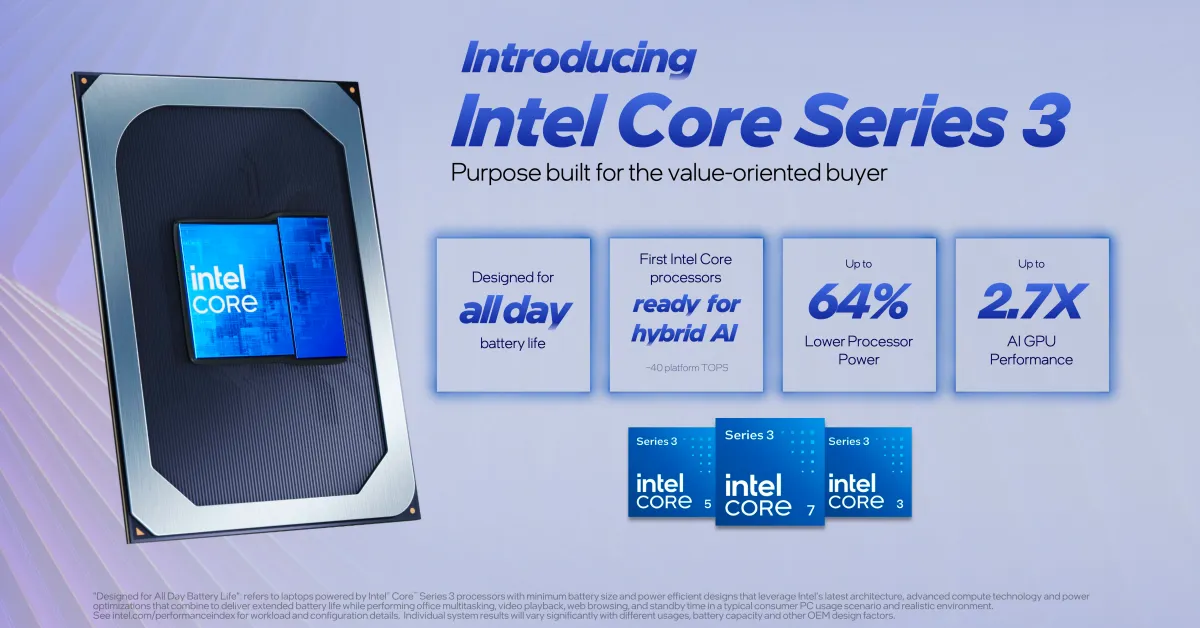
Intel has taken the wraps off a fresh batch of laptop processors designed for buyers who want modern performance without paying four-figure premiums. The new Core Series 3 chips, built on the same 18A Panther Lake architecture as the company’s flagship Core Ultra family, strip away some of the premium features to drive prices down for mainstream notebooks.
Six Processors, One Budget Mission
The Core Series 3 portfolio consists of six distinct models. While they share the Panther Lake foundation, each SKU is tuned for cost efficiency:
- Core 7 360 – six CPU cores
- Core 5 350 – six CPU cores
- Core 5 340 – five CPU cores
- Core 5 330 – five CPU cores
- Core 3 320 – five CPU cores
- Core 3 304 – five CPU cores (entry level)
Every model features a mix of performance and efficiency cores, integrated Intel Xe graphics, and sixth-generation NPU units for on-device AI. However, compared with their Ultra counterparts they have fewer of nearly everything: CPU cores, graphics execution units, cache, PCIe lanes, Thunderbolt ports, and theoretical AI throughput.
Key Differences From Core Ultra
Intel markets the Ultra line as its full-fat offering for premium ultrabooks, gaming laptops, and content-creation workstations. Core Series 3, in contrast, is tuned for day-to-day computing:
- CPU Cores – Up to six, versus up to ten in Ultra.
- Xe Graphics E-cores – Reduced counts mean lower 3D and compute performance.
- Cache – Halved on some models, curbing multitasking headroom.
- AI TOPS – About one-third of Ultra’s theoretical maximum, so heavier AI workloads may lean on the GPU or cloud.
- Pins and Lanes – Fewer PCIe Gen 5 lanes limit the number of high-bandwidth devices a laptop maker can attach.
- Thunderbolt 4 – Capped at two ports; Ultra supports up to four.
- TDP Range – Lower default thermal design power allows slimmer, fan-friendly chassis.
For everyday productivity—web browsing, office suites, and FHD media consumption—Intel expects these reductions to be barely noticeable. The real-world performance delta should only appear under sustained multi-core loads, intensive gaming, or local AI inference tasks.
Name Game: Potential for Confusion
Intel’s revised branding could puzzle shoppers. A Core 5 330, for instance, carries a higher sequence number than the Ultra 5 322 yet is objectively slower. The absence of the “Ultra” label is the clearest indicator that a chip belongs to the value segment.
Retailers and OEMs often headline laptops with a simple “Core 5” badge, so consumers will need to dig into spec sheets or retailer product descriptions to confirm whether they are looking at a Core Series 3 or a Core Ultra machine. Intel representatives have acknowledged the overlap but believe the simpler numbering system ultimately benefits mainstream buyers who previously juggled “i3,” “i5,” and “i7” tiers across multiple generations.
Which Laptop Makers Are on Board?
Major brands—including Acer, Asus, HP, Lenovo, Dell, and MSI—are expected to unveil notebooks powered by the new processors in the coming months. Entry-level gaming rigs, 13-inch ultralights, and mid-range 2-in-1 convertibles are the most likely form factors to benefit:
- Student and Small-Business Laptops – Lower BOM costs translate to more competitive price tags.
- Secondary Travel PCs – Lower heat output enables thinner designs without elaborate cooling.
- Affordable Creator Machines – While GPU horsepower is modest, Xe graphics still provide hardware acceleration for photo editing and 1080p video.
Early indications suggest manufacturers will aim for price points between $499 and $899, placing Panther Lake technology within reach of buyers who previously settled for outgoing 15- or 10-nanometer silicon.
Real-World Impact
Intel demonstrated reference laptops running productivity benchmarks at the product briefing. In side-by-side comparisons with last year’s Raptor Lake U-series chips, a Core 5 350 prototype shaved seconds off a multi-tab Chrome workload and rendered complex PowerPoint animations roughly 15 percent faster—all while drawing less than 20 watts sustained.
Gaming demos were more conservative. Titles like Fortnite and Valorant reached 60 frames per second at 1080p with medium settings on the Core 7 360. More demanding AAA titles, however, hovered in the 30–40 fps range, underscoring that dedicated GPUs or the Core Ultra models remain the better fit for heavier gaming.
Battery life gains may turn out to be the understated story. Intel claims up to 12 hours of mixed use in a 53 Wh test system, thanks to further refinements in efficiency cores and a smarter power management controller inherited from the Ultra line.
Why Panther Lake Matters at the Low End
Moving the entire stack—budget and premium—to a common 18A node simplifies driver support and speeds feature trickle-down. Every Panther Lake chip, even the cheapest Core 3 304, benefits from:

Imagem: Intel
- Sixth-Gen NPU – Basic on-device AI tasks such as noise suppression and webcam background blur run locally.
- Modern DDR5 and LPDDR5x Support – Faster memory at lower voltages improves battery endurance and integrated graphics performance.
- PCIe Gen 5 – Budget doesn’t mean slow SSDs; OEMs can spec high-speed storage if cost allows.
- Wi-Fi 7 Ready – With compatible radios, laptops can leverage next-gen network throughput.
In the past, entry-level buyers waited one or two generations before advanced features reached accessible price tiers. This simultaneous launch strategy could shorten that lag substantially.
How Low Can Prices Go?
Intel has not disclosed wholesale pricing, but analyst estimates place the Core 3 304 die at roughly 65 percent the cost of a comparable Ultra part. If OEMs pass along the savings, shoppers could see sub-$600 convertible laptops with OLED displays or thin-and-light PCs with 120 Hz panels—specifications previously reserved for $1,000-plus SKUs.
Still, final retail prices depend on component choices such as memory capacity, SSD size, and screen quality. Laptop makers may choose to pair the cheaper processors with premium materials or advanced cooling to carve out unique models at higher margins.
Outlook and Availability
The first wave of Core Series 3 notebooks is scheduled to arrive in late summer, aligning with the back-to-school window in North America and Europe. Larger retailers are expected to carry a broad spread of configurations, while online build-to-order channels will allow enthusiasts to fine-tune specs.
With AMD’s Strix Point APUs targeting a similar price segment and Qualcomm’s Snapdragon X chips pushing Arm-based Windows laptops toward mainstream adoption, the budget notebook space is set for intense competition. Performance-per-watt will remain the battlefield, and Intel believes Panther Lake’s efficiency upgrades give it an edge.
For now, the biggest question mark is how end-users will decode Intel’s new naming scheme. If manufacturers clearly label Ultra and non-Ultra devices—and if retailers filter search results accurately—the confusion may be short-lived. Otherwise, shoppers could find themselves reading spec sheets more closely than ever.
Frequently Asked Questions
Q: What is the main difference between Intel Core Series 3 and Core Ultra processors?
A: Core Series 3 chips have fewer CPU and graphics cores, less cache, reduced AI throughput, fewer PCIe lanes, and only two Thunderbolt 4 ports. They are tuned for lower power and cost, whereas Core Ultra targets premium performance.
Q: Are Core Series 3 processors suitable for gaming?
A: Light and esports gaming at 1080p should run comfortably on the top Core 7 360, but AAA titles at high settings will require a dedicated GPU or a Core Ultra machine.
Q: Will laptops with these chips support the latest connectivity standards?
A: Yes. Panther Lake architecture brings Wi-Fi 7 readiness, PCIe Gen 5 support, and DDR5/LPDDR5x memory even to entry-level models.
Q: How can I tell if a laptop has a Core Series 3 or a Core Ultra processor?
A: Look for the “Ultra” label in the processor name. A Core 5 330 is a non-Ultra part, while a Core Ultra 5 322 belongs to the premium tier despite the lower numeric suffix.
Q: When will laptops powered by Core Series 3 be available?
A: Manufacturers plan to ship the first models in late summer, with broader availability during the back-to-school season.