Tiny Cylinder, Mighty Breeze: How Dyson’s Mini Fan Handles Summer Heat—and Your Ears
When temperatures climb and shade is scarce, the promise of pocket-sized relief is hard to resist. Dyson’s new handheld fan, the HushJet Mini Cool, aims to deliver just that—a concentrated jet of air in a form factor no larger than a slim can of sparkling water. The company is asking $99.99 for the privilege, positioning the gadget as a premium companion for weddings, amusement parks, and sidewalk café lunches alike. After a week of steamy spring weather and several battery-draining tests, one thing is clear: the fan’s power borders on impressive, but its hush is more of a gentle shush.
A design that fits where phones go
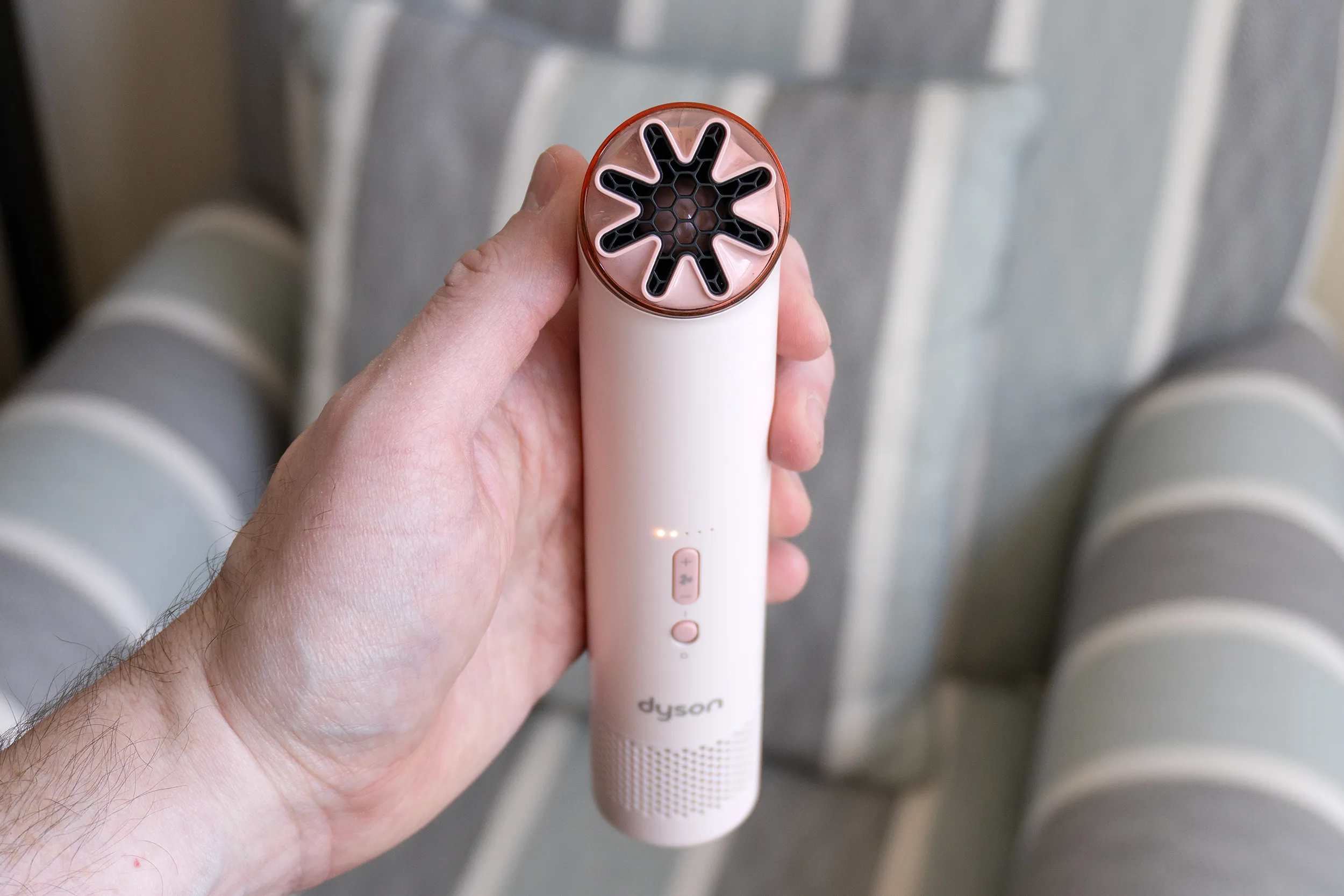
The HushJet Mini Cool’s biggest achievement is its shape. Instead of the exposed, fold-out blades you find on drugstore models, Dyson encases the entire mechanism in a 38 mm-wide aluminum cylinder. All the working parts—motor, 5,000 mAh lithium-ion battery, and impeller—sit behind a row of intake vents that wraps the bottom third of the body. At 208 g, it weighs about as much as the latest flagship smartphone and slips into the same pocket without the awkward bulge common to paddle-shaped fans.
That cylinder isn’t just for looks. By hiding the spinning blades, Dyson solves an overlooked problem: parents can hand the HushJet to children without worrying about tiny fingers meeting sharp plastic. It also means no stray hair gets caught, a blessing for anyone using the fan during a humid subway commute.
Controls you can master in seconds
Simplicity defines the interface. A small toggle activates the fan, while a rocker button steps through five speeds. Five white LEDs light up sequentially to show the current level; press and hold the plus side and a “Boost” setting springs to life, blasting noticeably stronger airflow as long as the button remains depressed.
- Speed 1: whisper of air, rated for up to six hours on a charge
- Speed 5: solid breeze, slightly louder than a quiet office printer
- Boost: short bursts of maximum output, useful when heat becomes oppressive
The only learning curve stems from those intake vents. Wrap your hand too low and you block airflow, cutting performance in half. A knurled grip or subtle texture ring would guide fingers instinctively, but for now users have to remember to hold the fan by its smooth mid-section.
Battery life that beats expectations—mostly
Dyson’s literature promises six hours on the lowest setting, and real-world testing matched that claim. On the opposite end, running at Speed 5 from a full charge drained the battery in one hour and two minutes. That figure may sound short, yet it outlasts most competitors that are half as powerful. When the battery finally conks out, a USB-C port on the base refuels the pack in roughly two and a half hours using a standard 15 W charger.
One annoyance: the five-dot battery gauge illuminates only when you switch the fan off. Monitoring remaining juice mid-session requires memorizing how long you have been running or toggling the power briefly. A live indicator would make planning easier on day-long outings.
Desk mode, with limitations
The fan’s center of gravity sits low, so it can stand upright on its own. Dyson bundles a doughnut-shaped accessory that widens the base for extra stability—handy on a vibrating train table or windy patio. Plug the fan into a power bank and it will run indefinitely, but desk mode has a caveat: the firmware caps the motor at Speed 1 whenever external power is detected. That restriction likely protects the battery, though it prevents the HushJet from doubling as a formidable night-stand fan.
Acoustics: quietish, not silent
With a name like “HushJet,” expectations run high. Dyson’s engineers say they tuned the motor to avoid shrill frequencies, and at lower speeds the tone does sound softer than bargain fans that whistle like dive bombers. Still, the device is not whisper-quiet. Using the NIOSH sound meter app on an iPhone, Speed 1 hovered around 39 dB when measured one foot away—roughly the volume of a calm library. Speed 5 spiked to 55 dB, comparable to an animated indoor conversation.
Imagem: Andrew LiszewskiCloseAndrew LiszewskiSen
Context matters. At an outdoor festival, the surge to Speed 4 blended into background noise, attracting no attention. During a lakeside wedding ceremony, anything above Speed 2 would likely draw sideways glances, though it remains far quieter than Dyson’s hair dryers or stick vacuums.
How it stacks up against rivals
For a reality check, testing pitted the HushJet against Nitecore’s izzCool 10 Pro, a fan that retails for roughly half the price. The Nitecore model produced airflow that felt equivalent to Dyson’s Speed 3 yet peaked at a lower sound level—about 44 dB. Dyson’s engineering edge showed up in pocketability: the izzCool’s clamshell housing protrudes, making it nearly impossible to store in slim jeans.
Another category, electric air dusters, offers wild airspeed but at deafening volumes. Models such as the Wolfbox MF100 can blow cracker crumbs clear off a mechanical keyboard, though no one sane would direct that blast at their face. Dyson’s mini fan strikes a middle ground: strong enough to cool skin in 95-degree heat, quiet enough not to resemble a leaf blower.
Real-world comfort tests
Throughout a 90-minute theme-park visit, the HushJet cycled among Speeds 2 and 3. The battery meter showed two dots remaining when the parade concluded, and the fan never felt cumbersome clipped to a belt loop by its lanyard strap. A night market run yielded similar results: plenty of breeze, occasional curious stares, zero overheated meltdowns.
Indoors, the story changes. Inside a muggy church sanctuary, using Speed 4 felt obtrusive, especially during quiet moments of reflection. Dropping to Speed 2 helped, though the airflow dipped enough that fanning oneself manually with a program handout became equally effective. For silent environments, shoppers may consider a slower, quieter alternative.
Value judgment
At $100, the HushJet Mini Cool costs two to three times what basic handheld fans command. Buyers are paying for Dyson’s trademark industrial design, the safety of enclosed blades, and an airflow-to-size ratio that leads the category. If absolute silence or rock-bottom pricing ranks higher on your priority list than maximum portable power, you will find satisfactory options elsewhere. But if you crave serious wind in a package that slips next to your phone, Dyson’s entry emerges as the front-runner—provided you can tolerate a mild whine.
Bottom line
The HushJet Mini Cool succeeds in delivering a breeze that belies its tiny frame, enough to keep sweat at bay on sweltering days. It is lightweight, thoughtfully engineered, and safer around kids than open-blade competitors. Just be aware that “hush” is relative: this mini turbine has a voice, and in quiet rooms it speaks up. For most outdoor adventures, however, the trade-off tilts in Dyson’s favor.
FAQ
- How long does the battery last on a single charge?
Up to six hours on the lowest speed and a little over one hour on the highest constant speed. Boost mode drains the battery faster because it exceeds the regular top setting. - Can the fan operate while plugged into a power bank?
Yes, but the firmware limits operation to the lowest speed whenever external power is connected. - Is the HushJet Mini Cool safe for children?
Because the blades are completely enclosed, fingers cannot reach the impeller, making it safer than traditional open-blade pocket fans. - Can I aim the airflow without tilting my wrist?
The nozzle rotates, allowing the user to direct air straight ahead, upward, or at an angle, which also enables hands-free use when the fan hangs from its lanyard. - Does it come with any accessories?
Included in the box are a USB-C charging cable, a detachable ring that broadens the base for desk use, and a fabric strap for carrying or hanging.