Spotify Deepens Literary Ambitions With Printed Book Sales and Smarter Audiobook Tools
Spotify’s march into the world of reading is moving from strictly digital listening to a hybrid experience that blends audio, ebooks, and now printed editions. The streaming giant has begun offering physical books for sale through a newly launched integration with Bookshop.org, while simultaneously upgrading its audiobook features to make switching between formats easier than ever.
Physical purchases arrive inside the Spotify app
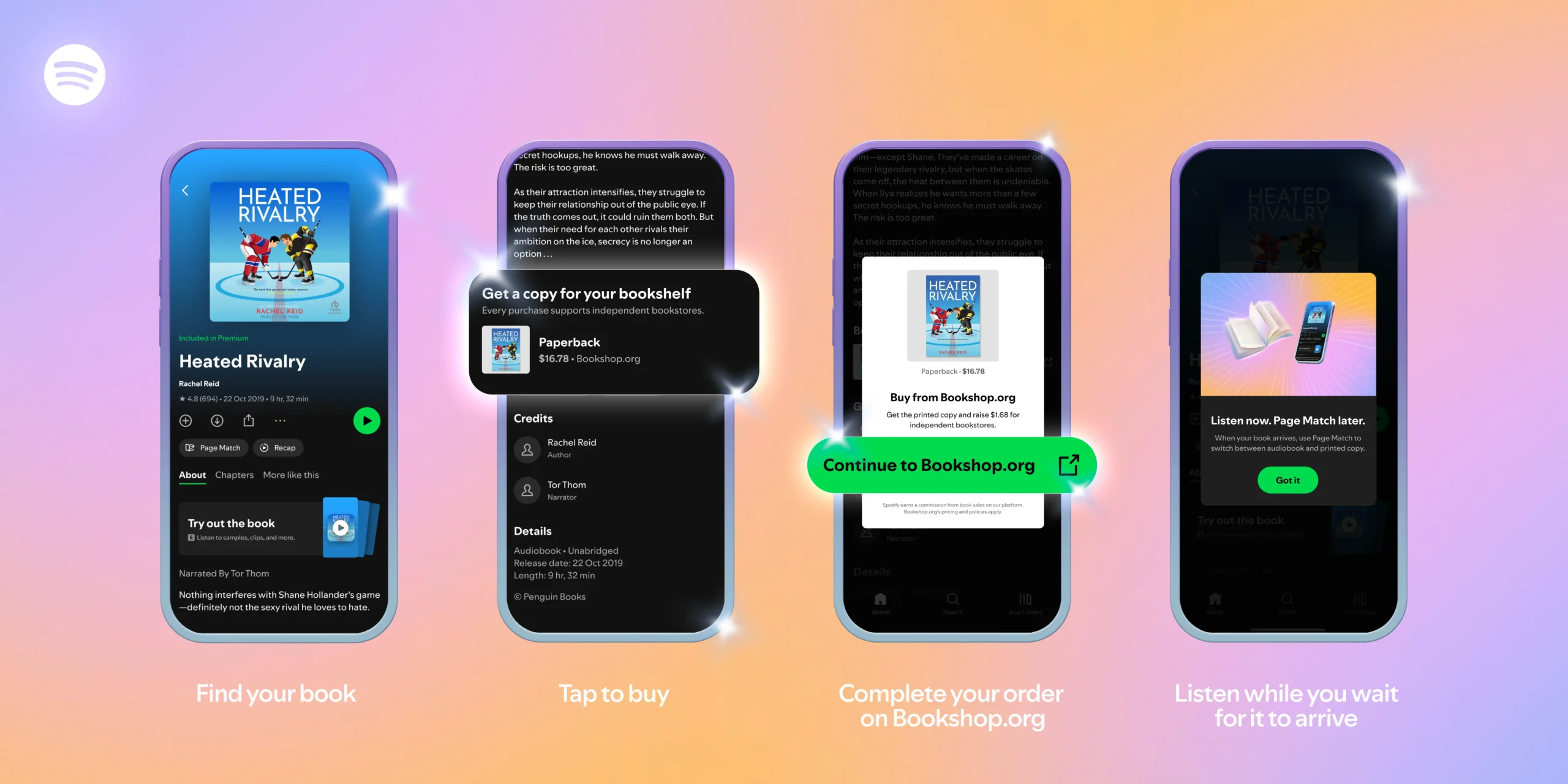
Starting this week, users in the United States and the United Kingdom can order printed books without ever leaving Spotify’s Android application. The company’s partnership with Bookshop.org, an online marketplace that supports independent bookstores, opens an in-app storefront that lists physical editions alongside audiobook and ebook options. iOS support is slated to follow next week.
Bookshop.org founder and CEO Andy Hunter hailed the collaboration when it was first announced earlier this year, emphasizing that widening the pool of potential readers benefits writers, publishers, and the smaller brick-and-mortar stores his platform represents. “Spotify is bringing in more readers, and I’m all for anything that grows the size of the pie,” Hunter said.
For Spotify, the move fills a gap that had separated the company from competitors that already bundle multiple reading formats. By letting listeners pivot from an audiobook to a printed copy straight from the same interface, Spotify inches closer to its ambition of becoming a one-stop destination for music, podcasts, and literature.
Upgraded tools for a seamless reading journey
The announcement goes beyond retail. Spotify is rolling out several quality-of-life improvements aimed at making it effortless to jump between audio and text:
- Page Match in more languages: The camera-based feature that syncs a user’s spot in a printed book—or an ebook—with the corresponding location in the audiobook is being extended to more than 30 additional languages, including French, German, Swedish, and others. A quick scan of the page lets the app identify where the listener left off, then resumes playback from the correct position.
- AI-powered Audiobook Recap on Android: Already available on iOS, this tool analyzes recently played chapters and generates a concise summary to refresh a user’s memory. The recap surfaces key plot points, characters, or arguments, so listeners can pick up an audiobook after a break without feeling lost.
- Expanded charts: The Audiobook Charts feature that tracks what titles are trending on Spotify is now accessible in Germany. In addition, a dedicated “Kids and Family” chart has launched in the US and UK, spotlighting age-appropriate stories and educational material.
“Whether it’s discovering a book the same way you’d find a song or podcast on Spotify, picking up the audiobook on your commute, using Page Match to switch to a physical copy at home, or jumping back in with a Recap, we’re making it easier for people to engage with books while supporting growth for authors and publishers along the way,” said Owen Smith, Spotify’s global head of audiobooks.
Why printed books still matter to a digital platform
Spotify’s decision to stock printed editions may appear counterintuitive for a service built on streaming, but physical sales bring several strategic advantages:
- Completeness of catalog: Some readers still prefer print for certain genres such as art books, cookbooks, or graphic novels that do not translate as well into audio.
- Higher margins on bundled formats: Offering multiple versions of the same title can encourage upselling, with users purchasing an audiobook plus a printed copy to suit different settings.
- Support for independent stores: Bookshop.org distributes proceeds to locally owned shops, aligning Spotify with a community-friendly narrative that resonates with consumers looking to support small businesses.
For Bookshop.org, partnering with a platform that boasts more than 600 million monthly active users dramatically expands exposure. Each sale made through Spotify still allocates a portion of revenue to independent bookstores, preserving the core mission of the marketplace.
Spotify’s broader audiobook play
The expansion into print is the latest step in a multi-year strategy to carve out a meaningful slice of the audiobook market. Since introducing audiobooks in 2022—and later bundling 15 hours of listening into its Premium subscriptions—Spotify has steadily layered on features to streamline discovery and improve usability:
- Editorial Recommendations: Human-curated lists highlight new releases, award winners, and niche categories.
- AI Narration Experiments: The company has tested synthetic voice technology to lower production costs for publishers.
- Podcast-Audiobook Crossover: In select cases, podcast hosts have released companion audiobooks, leveraging existing audiences.
Industry analysts view these moves as an effort to challenge the long-entrenched dominance of Audible. While Amazon’s audiobook arm still commands a larger share of paid downloads, Spotify’s freemium distribution model, recommendation algorithms, and enormous user base could reshape consumer habits—particularly among younger listeners who already rely on the app for music and podcasts.
How the Bookshop.org integration works
Inside the Spotify app, users will notice a new “Buy in Print” button on applicable book pages. Tapping the link opens a mini-storefront powered by Bookshop.org’s back-end. Shoppers can view price, shipping options, and estimated delivery times without forcing an external browser jump—reducing friction that often deters impulse purchases.
Payment is processed through Bookshop.org’s secure checkout, and orders are fulfilled by partner bookstores closest to the customer’s address. The design maintains Spotify’s visual language, so the shopping flow feels native rather than bolted on. Spotify does not disclose its revenue split, but both companies emphasize that independent stores receive the same cut they would through Bookshop.org’s main site.
Implications for publishers and authors
The ability to surface all available formats in one place strengthens a book’s visibility and could lift overall sales. An author releasing a new novel, for instance, can benefit from Spotify’s playlist algorithms, social sharing tools, and push notifications to reach audiences that traditional book marketing might miss.
Imagem: Spotify
Publishers, meanwhile, gain a data-rich environment to analyze reader behavior. Metrics such as completion rates, skip points, and recap usage highlight how audiences engage with specific chapters or themes. Over time, these insights might inform editorial decisions, audiobook production budgets, and cross-format promotional tactics.
Challenges on the horizon
Despite the promise, several hurdles remain:
- Licensing complexity: Securing rights for global distribution across multiple formats can be labor-intensive, especially for backlist titles tied up in legacy contracts.
- Monetization balance: Spotify must ensure that bundling audiobook hours into Premium plans does not erode perceived value for publishers used to a pay-per-title model.
- User education: Convincing a primarily music audience to buy printed books will require intuitive design cues and sustained promotion inside the app.
Still, the convergence of physical and digital formats under one umbrella positions Spotify as a distinctive player in the crowded literary landscape. If the experiment succeeds in the US and UK, expansion into additional markets seems likely, particularly in regions where Bookshop.org already maintains a supply network.
What comes next?
Rumors circulate that Spotify is exploring further AI-driven reading aids, such as automatic pronunciation guides for language learners and interactive chapter quizzes for students. The company has not confirmed timelines, but the pace of recent updates signals an aggressive product roadmap.
For now, readers, listeners, and hybrid consumers can test the new tools immediately on Android or wait for the iOS rollout next week. Whether you prefer turning pages or tapping earbuds, Spotify wants to meet you where you are—and perhaps sell you a hardback on the way.
FAQ
How do I buy a printed book on Spotify?
Open the book’s detail page in the Spotify app, tap “Buy in Print,” and complete checkout through the integrated Bookshop.org window.
Is the feature available worldwide?
Currently, printed book sales through Spotify are limited to users in the United States and the United Kingdom. Additional regions may follow after the initial rollout is evaluated.
Do independent bookstores benefit from these purchases?
Yes. Bookshop.org routes a portion of each sale to participating local bookstores, ensuring they share in the revenue.
When will iOS users gain access?
Spotify says support for iOS will arrive next week, assuming final testing proceeds as planned.
What languages now support Page Match?
More than 30 new languages have been added, including French, German, Swedish, Dutch, and Italian, among others.