DJI introduces Osmo Pocket 4 with enhanced slow-motion, integrated memory and creative lighting, but U.S. release remains on hold
DJI has taken the wraps off the Osmo Pocket 4, the fourth-generation version of its palm-sized, three-axis gimbal camera aimed at vloggers, travelers and content creators. While the new model preserves the pocket-friendly form factor that defined its predecessors, it brings meaningful upgrades in imaging performance, user controls and creative flexibility. Consumer excitement in the United States, however, must wait; the company says regulatory authorization is still pending, and the camera will initially ship only to markets such as Europe and the United Kingdom.
Familiar silhouette, significant revamp inside
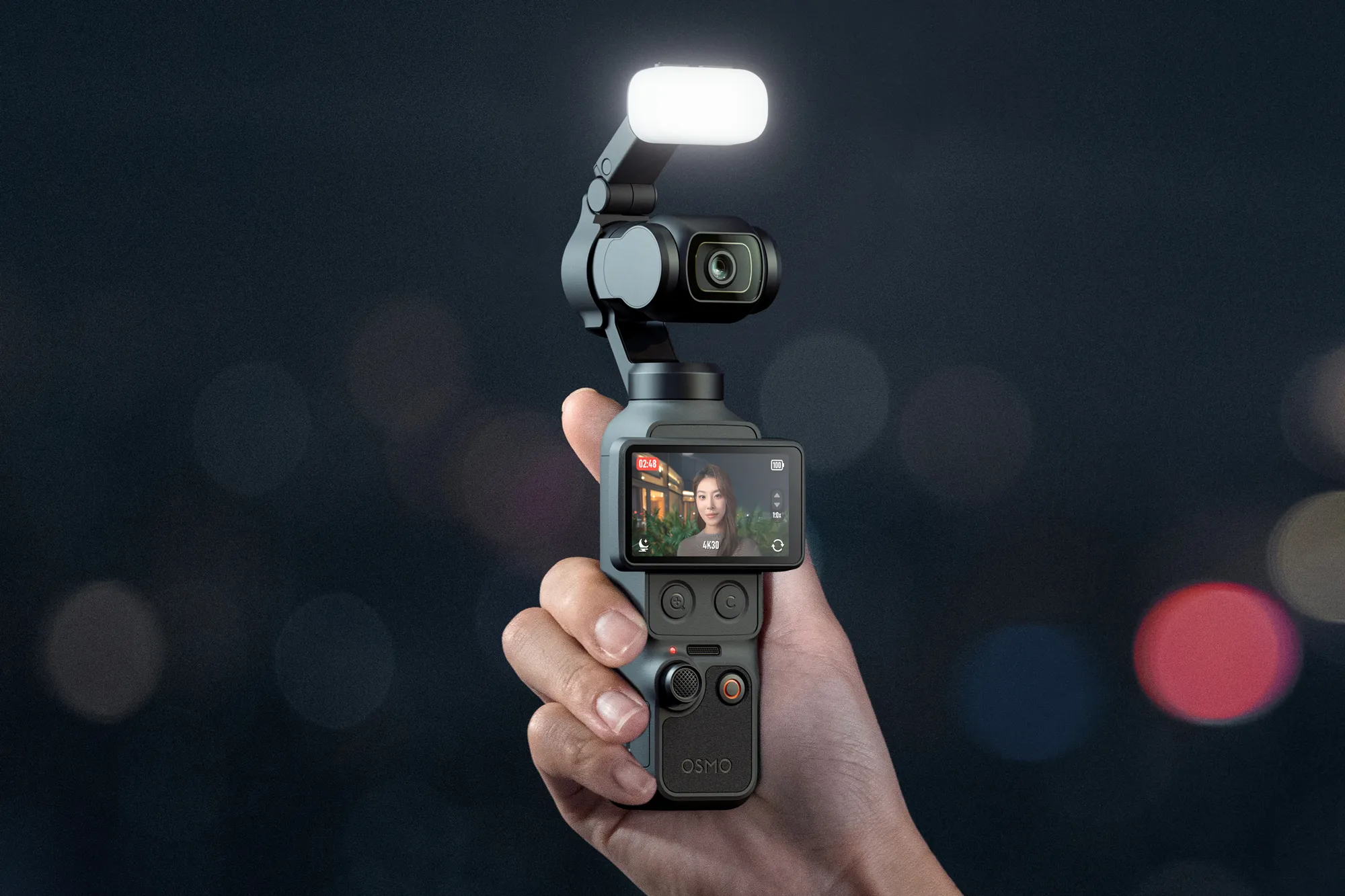
From a distance, the Osmo Pocket 4 looks much like the 2023 Osmo Pocket 3. The handset-style grip, swiveling 2-inch OLED touchscreen, and three-axis mechanical gimbal all remain. Yet DJI’s engineers focused on areas that early adopters considered most important: sensor size, slow-motion frame rates, dynamic range, storage and low-light support. The result is a device that captures more detail, handles tricky lighting with greater finesse, and offers shooters a bit more creative headroom out of the box.
1-inch sensor delivers broader dynamic range
At the heart of the redesign is a 1-inch type CMOS image sensor capable of drawing in more light than the 1/1.7-inch component used previously. DJI states that the sensor now achieves 14 stops of dynamic range, meaning the camera can simultaneously preserve highlight information in bright skies and retain detail in shadowed areas. For travelers who often find themselves filming high-contrast landscapes or cityscapes, the expanded range can reduce reliance on exposure bracketing or post-production recovery.
The larger photosite area also promises cleaner imagery in dim environments. Nighttime street scenes, concert venues and indoor vlogs should show less noise thanks to the additional photons each pixel can collect. According to DJI’s lab tests, low-light signal-to-noise ratio improves by as much as 30 percent compared with the Osmo Pocket 3.
Slow-motion in 4K up to 240 frames per second
High-frame-rate recording receives its biggest jump in three product generations. The Osmo Pocket 4 can now capture 4K footage at up to 240 fps, quadrupling the maximum speed offered by its predecessor in that resolution. Content creators get eight-times slow-motion playback (from 30 fps base timelines) without sacrificing Ultra HD detail. Lower resolutions such as 1080p also support the 240 fps ceiling, allowing users to squeeze every drop of smoothness out of fast-moving subjects such as skateboard tricks or splashy water sports.
Still resolution climbs to 37 megapixels
For photographers, the Osmo Pocket 4’s still image output upgrades from 9.4 MP to a robust 37 MP. DJI credits an “optimized computational photography algorithm” for the jump, implying pixel-binning or oversampling techniques that extract additional detail from the 1-inch sensor. Landscape shooters can now crop with confidence, and social media influencers gain more leeway to punch in on a selfie without quality falling apart.
An expanded control palette
Below the familiar rotating screen reside two newly added hardware buttons. One cycles through preset focal length multiples—1×, 2× and 4× digital zoom—while the second can be customized to launch frequently used settings or modes. Together, they reduce the need to dig through touchscreen menus mid-shoot.
The joystick has also been overhauled and now functions as a so-called “5D analog” nub. Depending on directional pressure, users can:
- Spin the gimbal 180 degrees to switch from rear-facing to selfie mode
- Pan or tilt the camera at variable speeds for cinematic moves
- Double-press to recenter the gimbal instantly
- Triple-press to trigger a rapid 180-degree viewpoint reversal
ActiveTrack 7.0 keeps subjects locked
DJI’s subject-tracking technology enters its seventh iteration and, for the first time, maintains reliable lock even when the user zooms up to 4×. The firmware recognizes vehicles, pets and people, but also allows operators to tag a particular face that the camera should prioritize. Gesture control returns, so an on-screen performer can start and stop recording with a simple raised palm or two-finger V-sign—indispensable for solo creators without a camera assistant.
Onboard memory means one less card to forget
The Osmo Pocket line has always accepted microSD cards, and that slot remains. New, however, is 107 GB of internal NVMe storage rated at transfer speeds of 800 MB/s. Creators who run out the door without a card can still squeeze in roughly two hours of 4K60 footage—or several thousand 37-megapixel JPEGs—before worrying about offloading.
Film tone filters and cosmetic touch-ups
DJI leans into color science this year with six new “film tone” profiles. One, inspired by Fujifilm’s iconic stock, lays down cooler hues with softened contrast, while another emulates warm, nostalgic celluloid. For users shooting portraits, built-in beauty filters smooth skin or brighten complexions, streamlining quick posts when time for detailed grading is scarce.
Magnetic fill light adds polish in tight spaces
Lighting can make or break a vlog, so DJI created a detachable, magnetic fill light bundled in the top-tier Creator Combo. The accessory snaps beneath the gimbal and offers:
Imagem: Andrew LiszewskiCloseAndrew LiszewskiSen
- Three brightness intensities for modest to strong fill
- Three color temperature presets—cool daylight, neutral white and warm tungsten
- USB-C charging independent of the camera, preserving battery life on extended shoots
Although miniature, the lamp can gently lift shadows under hats or noses, especially useful when shooting during golden hour or inside poorly lit cafés.
Bundles and regional availability
At launch, buyers can choose among three kits:
- Essential Combo (€429/£479, roughly $565–$580) – camera, protective pouch and tripod-ready handle.
- Standard Combo (€445/£499, roughly $588–$604) – adds wrist strap and gimbal clamp for travel security.
- Creator Combo (€549/£619, roughly $730–$745) – further includes magnetic fill light, mini tripod, wide-angle lens attachment and a wireless DJI Mic 3 transmitter with mounting accessories.
All packages ship to European Union countries, the United Kingdom and selected Asian markets beginning this month. A spokesperson confirmed that distribution in the United States is delayed while the company awaits final regulatory clearance. No firm timeline has been disclosed.
Competitive landscape
The Osmo Pocket 4 enters a crowded field of portable cameras that includes conventional action cams, smartphone gimbals and mirrorless interchangables. Yet its unique mix of 1-inch sensor, mechanical stabilization and pocketable form factor continues to set it apart. Rivals using electronic stabilization alone can struggle in low light or during fast pans, whereas DJI’s three-axis gimbal mitigates jitter without aggressive cropping.
Smartphones with comparable sensors often require bulky cages and motorized holders to match the Osmo’s stabilized output. Mirrorless bodies, while superior in outright image quality, are heavier, pricier and less discreet for casual street filming. As a result, the Osmo Pocket 4 slots neatly into a “grab-and-go” niche—lighter than a full rig, but more capable than a phone strapped to a selfie stick.
Early impressions from creators abroad
European reviewers who have spent a week with pre-production units praise the expanded dynamic range and the convenience of internal storage. Some note that 240 fps footage exhibits slight softness compared with standard 4K60, but the trade-off remains worthwhile for dramatic slow-motion sequences. The magnetic lamp, while petite, reportedly brightens faces enough for nighttime street interviews.
Battery life appears largely unchanged from the previous generation. DJI rates it at roughly 166 minutes when recording 1080p/24 but closer to 115 minutes at 4K/60. As before, users can supply continuous power through USB-C if shooting lengthy podcasts or stationary livestreams.
Outlook for U.S. enthusiasts
For American creators eager to upgrade, the waiting game continues. Industry analysts believe the holdup may relate to wireless certifications tied to the integrated Wi-Fi/Bluetooth module used for smartphone control and livestreaming. If prior DJI product launches are any indicator, approval could arrive within months, though geopolitical trade tensions occasionally complicate the process.
In the meantime, gray-market imports are likely, but buyers should be aware that regional firmware variants may limit certain features, and service warranties may not extend across borders. Those prepared to wait can expect official pricing to align closely with European equivalents once the green light is granted.
Bottom line
With a bigger sensor, buttery 4K240 slow-motion, integrated high-speed memory and thoughtful quality-of-life touches, the Osmo Pocket 4 refines an already beloved content-creation tool. Its absence from U.S. store shelves at launch is a disappointment, yet the international rollout signals DJI’s confidence that handheld gimbals remain relevant in a smartphone-centric world. For travelers, daily vloggers and social storytellers in approved regions, the upgrade appears compelling; and for American fans, the promise of smoother, sharper footage could be worth the wait.
FAQ
- When will the Osmo Pocket 4 be available in the United States?
DJI has not provided a specific date. The company is seeking regulatory authorization and will announce U.S. availability once clearance is obtained. - Does the camera require a microSD card?
No, it features 107 GB of built-in NVMe storage. However, a microSD slot is still present for those needing additional capacity. - Can the magnetic fill light be purchased separately?
DJI has not yet confirmed standalone accessory pricing. For now, the light is included in the Creator Combo bundle. - What video formats does the Osmo Pocket 4 support?
The camera records in H.264 and H.265 codecs with a maximum resolution of 4K and frame rates up to 240 fps. - Is the new ActiveTrack 7.0 compatible with previous Osmo Pocket models?
No, ActiveTrack 7.0 is exclusive to the Osmo Pocket 4 and is tied to its updated processor and firmware. - How does the joystick differ from earlier versions?
The new 5D analog joystick offers variable-speed pan/tilt, quick flip to selfie mode, and recenter functions, providing finer manual control.