Quirky Camera Trades Photos for Verse, but Inspiration Gets Lost in Translation
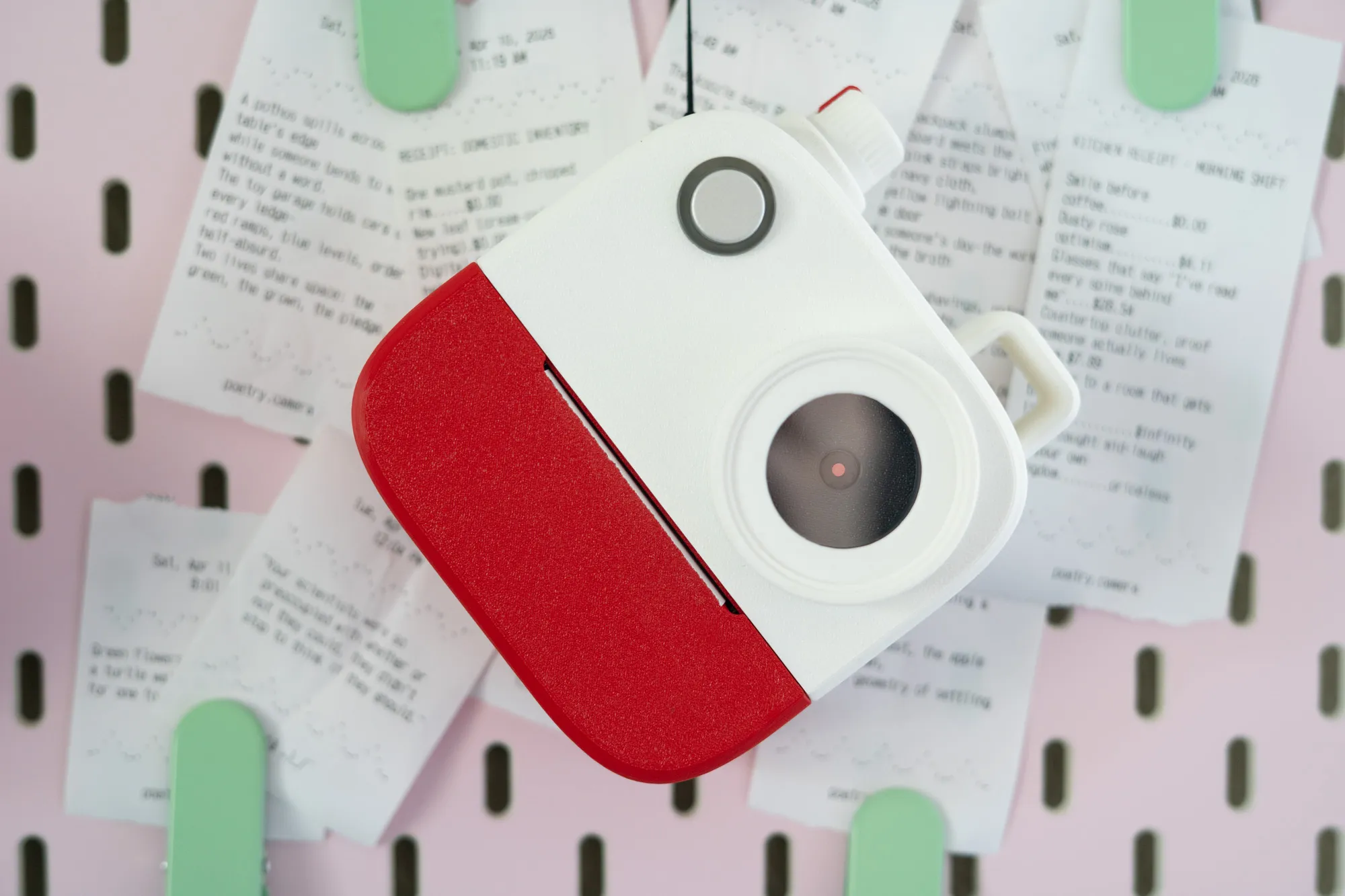
A small, candy-colored box sits on the dining-room table, its cherry-red accents glowing faintly as an LED ring circles the shutter button. It looks like something you might pull from a retro toy catalog: part instant camera, part lunchbox, entirely charming. Lift it, press the shutter, and—rather than the familiar whirr of an instant photograph developing—you hear the buzz of a thermal printer at work. Moments later, a thin strip of receipt paper curls out. On it: a poem, supposedly inspired by whatever scene the lens just captured.
This is the Poetry Camera, a Kickstarter-style passion project that has stumbled into limited commercial reality. Born from a collaboration between designer Kelin Carolyn Zhang and former software engineer Ryan Mather, the palm-sized gadget promises to transform everyday moments into literary keepsakes generated by a cloud-based language model. In practice, it delivers something closer to novelty fortune-cookie philosophy: earnest, occasionally evocative, but rarely memorable.
How it Works
The device lacks both a viewfinder and a display. Instead, users compose shots by guesswork, press the chunky shutter, and wait roughly half a minute. During that time, the Poetry Camera performs three key steps:
- Uploads a low-resolution image to a remote server via Wi-Fi.
- Feeds a pre-written prompt—selected by a dial on the top plate—to an AI text generator.
- Prints the resulting stanza (or limerick, or haiku) on two-inch thermal paper.
Connectivity is established through a clever QR-code system: open a web app on any phone or laptop, log into your home network, and a code appears onscreen. Point the camera at the code and, like magic, it joins the network without ever needing a companion smartphone app. When everything behaves, the process feels almost whimsical. When it fails—a not-infrequent occurrence—the camera clicks, sputters, and spits out an “error poem” that is cute the first time, exasperating the tenth.
Design: Toy-Like on Purpose
Visually, the Poetry Camera feels intentionally lo-fi. The body is matte white plastic; the strap is woven to match the red accents. There are no ports or buttons beyond a power toggle, a dial for choosing poem style, and the shutter itself. Even the power indicator doubles as an aesthetic flourish. It is the sort of object that invites conversation at parties, and the designers clearly know it. Their marketing leans hard on physical charm to compensate for what the device can—and can’t—do.
From Idea to Assembly Line
The first prototypes were literal cardboard boxes fitted with Raspberry Pi boards and thermal printer modules. After early social-media buzz, a small batch of hand-assembled units sold for a steep $699. Feedback was mixed: delightful concept, rough execution. Zhang later relocated production to a Shenzhen factory while participating in an MIT residency, re-engineering the internals for greater consistency and halving the price to $349. That second run sold out quickly, and a third batch is slated for release later this spring.
Customization: A Playground with Guardrails
The companion portal allows owners to rewrite the prompts that guide the AI. Out of the box, turning the top-plate dial cycles through poetic forms—haiku, free verse, sonnet, and so on. Dive into the web interface, however, and the possibilities widen. In theory, you can instruct the model to produce anything: motivational quotes, fun facts, comedic roasts. In reality, the system guards its rails tightly. The AI prefers to default to “poetry,” and getting it to break the habit often requires explicit instructions like “do not write a poem.” Some prompts work beautifully—one user reports receiving perfectly timed Jurassic Park quotes keyed to object recognition—while others trigger vague error slips. Because each failed attempt puts the camera back into sleep mode, iterative tinkering soon becomes a patience test.
The Friction Points
- Network Dependency: No Wi-Fi, no verse. Cellular hotspots prove unreliable, and there is no offline mode.
- Thermal Paper Limitations: Prints fade within months unless stored carefully, undermining the device’s claim to create lasting keepsakes.
- Ambiguous Errors: The same whimsical error poem appears whether the Wi-Fi drops, the server times out, or a prompt violates content policy, leaving users guessing.
- Soul Question: Even the best outputs sound algorithmic—balanced on the edge of profundity but rarely tipping into genuine emotion.
When Novelty Wears Off
On first encounter, the Poetry Camera evokes the same wonder many people felt the day they first asked ChatGPT to write a Shakespearean ode to a breakfast burrito. But novelty depreciates quickly. After a dozen or so strips have piled up on the coffee table—each with similarly airy, generic language—the sense of magic drains away. The device still surprises in small doses, particularly when a customized prompt lands just right, but the hit rate remains inconsistent.
That inconsistency underscores a broader cultural shift: two years ago, watching an LLM churn out passable verse felt revolutionary. Today, it feels ordinary. The camera, unavoidably tethered to that earlier moment of AI enchantment, risks becoming an anachronism just as it starts shipping in volume.
Is It Art?
The central question haunting every AI-assisted creative tool looms large here: If a machine rearranges language based on statistical likelihood, does the output qualify as poetry? Traditionalists argue that poetry is inseparable from human interiority—the lived experience, empathy, and conscious intent of its author. Without a beating heart behind the words, the work may resemble verse but lacks the ineffable spark we call soul.
The Poetry Camera sidesteps that debate by framing itself as playful experimentation rather than high art. Yet the device’s entire premise leans on the romantic notion of poetry as a distillation of feeling. The mismatch between that aspiration and the blankness of algorithmic prose leaves some users, especially poets and literature lovers, feeling more disenchanted than inspired.
Use Cases That Do Make Sense
- Event Guestbooks: Set up the camera at a wedding or gallery opening and invite guests to snap scenes. Even middling verse doubles as a timestamped souvenir.
- Icebreakers: At workshops or corporate retreats, printed poems can spark conversation faster than yet another PowerPoint slide.
- Kids’ Creativity Sessions: Children respond well to the tangible nature of thermal printouts, and tweaking prompts toward silly jokes or riddles keeps the fun factor high.
- Hardware Hacking: Tinkerers will appreciate the Raspberry Pi roots, which make firmware mods theoretically possible once warranties expire.
Value for Money
$349 buys plenty of conventional photography gear—or more paper, ink, and film for an instant camera that produces actual images. Thermal rolls are inexpensive, but replacement print heads and batteries are not. Owning a Poetry Camera, then, is less about utility and more about participating in a conceptual art project. If that idea thrills you, the price might feel fair. If your interest is casual, waiting for the secondary market—or borrowing from a curious friend—makes more sense.
Imagem: Allis JohnsCloseAllis JohnsPosts
The Verdict
The Poetry Camera is a fascinating artifact of the early-AI zeitgeist: half design object, half social experiment. It proves that a clever form factor and an ambitious concept can capture imaginations, at least briefly. It also exposes the limits of today’s language models when pressed into service as automated muses. For those who delight in gadgetry for its own sake, it is worth a weekend of exploration. For seekers of lasting artistic resonance, it is unlikely to satisfy.
Ultimately, the device succeeds on its own quirky terms—producing ephemeral verse on demand—but fails to answer the deeper question it inadvertently poses: Can a poem exist without a poet?
FAQ
How do you set up the Poetry Camera?
You visit a simple web page, enter your Wi-Fi credentials, and a QR code appears. Aim the camera at the code, and the device joins your network automatically.
Does it store the photos it takes?
No. Images are uploaded temporarily to generate text, then discarded. The only permanent record is the printed thermal strip.
Can I replace the thermal paper?
Yes. The camera uses standard 2-inch thermal receipt rolls, widely available online and in office-supply stores.
Is there a way to save or share the poems digitally?
Not natively. You’ll need to scan or photograph the printouts if you want a digital copy.
Can I disable poetry and print other content?
Partially. The web portal lets you rewrite prompts, but you must explicitly tell the AI not to produce verse. Even then, success can vary.
Does the device work without Wi-Fi?
No. All text generation occurs in the cloud, so an internet connection is mandatory.
How long do the printouts last?
Thermal paper is susceptible to fading, especially when exposed to heat, light, or oils from skin. Expect noticeable degradation within a year unless stored carefully.
Is new hardware planned?
The creators have hinted at a third manufacturing run with minor tweaks but have not announced a next-generation model.