Facial-Scanning Orbs Begin Granting Digital Passports Across Popular Apps
The struggle to prove you are a real, flesh-and-blood human on the internet has taken a sci-fi twist: metallic orbs the size of a bowling ball are now scanning faces and irises to vouch for users on dating services, videoconferencing platforms, and even electronic signature tools. A project called World ID, co-founded by OpenAI chief executive Sam Altman, is moving beyond pilot tests and rolling out its so-called “orb verification” in the United States and Japan after running a limited trial last year.
How the orb works
At the center of the initiative is a silver, sensor-laden sphere that resembles a prop from a near-future thriller. Anyone who wants an official World ID must visit one of these devices in person. The orb captures high-resolution images of the user’s face and detailed biometric patterns in the iris, generating a unique code that World ID says cannot be reverse-engineered to reconstruct the original images. According to the company, all data is encrypted and stored only on the user’s phone by default, rather than in a centralized database.
The pitch is straightforward: once that biometric check is complete, a user receives a cryptographic credential—essentially a “proof of personhood”—that can be shared with partner apps to demonstrate they are not a bot or an AI deepfake. Instead of continually handing over sensitive documents, a single scan becomes a reusable digital passport for multiple services.
Tinder offers free boosts for verified humans
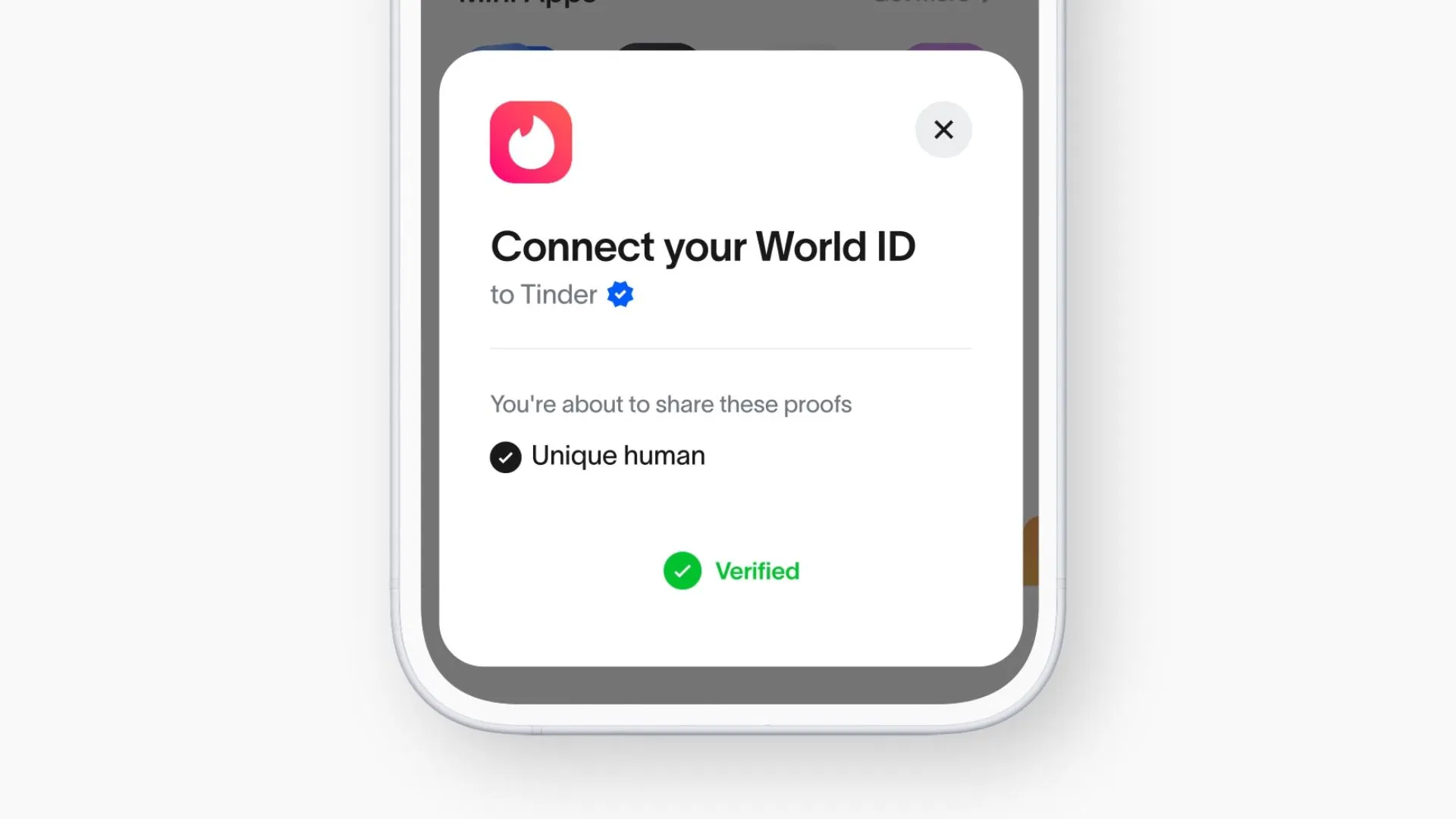
The highest-profile partner so far is Tinder. Users who link a World ID to their dating profile will see a verified human badge, signaling to potential matches that they have met the orb in person. For a limited period, Tinder is sweetening the deal with five complimentary Boosts, the paid feature that amplifies a profile’s visibility for 30 minutes at a time. In practice, that could translate into dozens—or hundreds—more right-swipes.
Tinder already supports verification through one-time selfie photos and government ID uploads. The company says those options will remain, but the free Boost promotion is exclusive to World ID participants. The incentive underscores how platforms are wrestling with an explosion of fake and automated accounts, especially as generative AI makes it cheaper and faster to create realistic profiles and messages.
Zoom and DocuSign integrations signal a broader push
World ID’s ambitions are not limited to online romance. The group confirmed that its credential now works with Zoom and DocuSign, two staples of remote work. During a live video meeting, for instance, a host could require participants to prove they are genuine people before joining, potentially foiling trolls who rely on anonymous burner accounts. On DocuSign, the verification might sit alongside or replace the familiar driver’s-license check, adding another layer of confidence that the signature belongs to a real constituent rather than a synthetic imposter.
To manage these permissions, World is launching a dedicated World ID app—separate from the broader “World” super app it teased last year—that acts as a wallet for the proof-of-human credentials. Users can decide which services receive their confirmation token and review a log of every time their ID has been used.
Expanding from pilot to production
The orb network first went live in Japan in 2025 as a small-scale proof of concept. Thousands of early adopters lined up at pop-up events in Tokyo and Osaka, driven in equal parts by curiosity and promotional gifts from partner brands. Feedback from that pilot convinced the company to refine its privacy messaging and streamline the enrollment process, ultimately paving the way for today’s wider launch that now includes select American cities.
World says it will deploy more orbs in shopping malls, co-working spaces, and tech conferences through the summer. Each device requires a staff member on site to address questions and sanitize the scanner between sessions, so the rollout is incremental rather than overnight. A typical scan takes under a minute, but lines can build quickly in high-traffic areas.
Privacy concerns remain front and center
Any system that asks the public to sit for biometric photography is bound to face scrutiny. Civil-liberties advocates warn that storing face and iris data—even locally—creates new risks if the phone is hacked or if users unknowingly back up files to a cloud account. They also point out that cryptographic hashing does not eliminate every avenue for abuse; enough token leaks could still allow an attacker to correlate World ID usage across services and piece together a behavioral profile.
World counters that its architecture is designed specifically to prevent widespread surveillance. The orb captures images, converts them into an irreversible numeric code, and immediately deletes the raw photos once the conversion is verified. The company also publishes parts of its codebase and invites security researchers to audit for vulnerabilities. Still, skeptics say assurances are only as strong as the trustworthiness of the organization operating the hardware—and ultimately the confidence of regulators.
The competitive landscape of identity verification
World ID is entering a busy field. Financial institutions, social networks, and age-restricted content sites already rely on Know Your Customer (KYC) processes that ask for passports or driver’s licenses. Meanwhile, other tech firms are experimenting with AI-driven selfie authentication or behavioral analytics that study typing patterns and mouse movements.
The orb strategy stands out because it bundles two elements usually kept apart: on-premise, hardware-based enrollment and cross-platform portability. A single trip to the orb yields a credential intended to be shown everywhere, compared with most KYC solutions that recreate the identity check each time you sign up for a new service. If the program scales, users could bypass repetitive form filling and share only a binary “yes, I’m human” flag without exposing additional personal details.
Imagem: World
Potential pitfalls and regulatory hurdles
Regulators in Europe and parts of Asia have stringent rules governing biometric data, and the United States is inching toward clearer guidelines. World says it will comply with region-specific laws, including the General Data Protection Regulation (GDPR) in the EU and state-level privacy statutes such as the California Consumer Privacy Act (CCPA). Whether that framework satisfies watchdog agencies remains to be seen, especially if the orb’s usage balloons in sensitive sectors like health care or voting.
There is also the question of inclusivity. Not everyone can easily travel to an orb site, and some individuals—particularly in marginalized communities—may be reluctant to undergo face and iris scans. If more apps start making orb verification a requirement for premium features, skeptics warn that a two-tier internet could emerge, dividing those who consent to biometric checks from those who do not.
Where the technology might go next
For now, the company is focused on onboarding consumer applications, but executives have hinted at longer-term goals that extend to e-commerce and digital governance. A shopping site could, in theory, ask for proof of humanity before accepting customer reviews, curbing the plague of fake five-star ratings. Municipal governments could require the credential for online petitions or town-hall forums, reducing spam without squelching anonymity entirely.
Much will depend on user appetite. If Tinder participants report better matches and fewer scams, that success story could encourage additional platforms to adopt orb checks. On the other hand, any data breach or high-profile misuse could stall momentum and send users back to more familiar ID cards and selfies.
What to expect if you book an orb appointment
- Locate a site: Use the World ID app map to find the nearest orb kiosk. Availability is currently limited to major cities in the United States and Japan, but more locations are planned.
- Bring your phone: The credential is stored locally on your handset, so you will need it during the scan to pair with the orb.
- Undergo the scan: A technician guides you through positioning. The orb flashes softly as it photographs your face and captures an infrared image of your irises.
- Review and accept: On your phone, you approve the conversion of the images into an encrypted code. Raw photos are deleted once processing is confirmed.
- Connect to apps: Open Tinder, Zoom, or DocuSign and grant permission for each service to view your human verification badge.
The bottom line
Orb-based verification is the most tangible attempt yet to attach a tamper-resistant identity layer to everyday consumer apps without repeatedly exposing sensitive documents. Whether it becomes a cornerstone of online life or a niche curiosity will depend on privacy safeguards, regulatory acceptance, and, above all, public trust. For daters chasing extra visibility, office workers fending off meeting crashers, and anyone tired of re-uploading their driver’s license, the next few months may offer the first real-world verdict.
FAQ
How much does it cost to get a World ID?
Enrollment is currently free. However, visiting an orb may require travel, and there is no guarantee the service will remain cost-free as demand grows.
Do I need World ID to keep using Tinder, Zoom, or DocuSign?
No. All three platforms still allow traditional verification methods. Orb verification is an optional add-on that unlocks specific perks, such as free Boosts on Tinder.
What happens if I lose my phone?
World says you can revoke your old credential and restore it on a new device, but you must still prove ownership of the original identity through recovery phrases set during enrollment.
Can someone steal my biometric data from the orb?
The company claims raw images are deleted immediately after processing. The resulting code is useless without the private key stored on your device. Critics caution that no system is completely immune to breaches.
Is this the same as Worldcoin’s cryptocurrency project?
World ID shares founders with the Worldcoin token initiative and uses the same orb hardware. However, World ID focuses on digital identity, while Worldcoin deals with a cryptocurrency token distribution system.