

Nvidia’s Open-Source Quantum Push Shakes Up a Niche Market and Spotlights an Unexpected Beneficiary
Shares of Nvidia have spent years rallying on the explosive growth of artificial-intelligence hardware, but the company’s latest catalyst comes from a much smaller frontier: quantum computing. After long voicing doubts about the near-term usefulness of quantum machines, chief executive Jensen Huang has reversed course, unveiling a suite of open-source AI models—collectively branded “Ising”—meant to solve two of the field’s toughest problems: calibration and error correction. The announcement, made on April 14, ignited a spectacular week-long surge in quantum-computing equities and, perhaps more significantly, shifted investor attention toward a comparatively obscure player that enjoys unusually deep ties to Nvidia.
From Skeptic to Champion
Huang’s pivot is notable because it comes only fifteen months after he publicly questioned whether quantum computers would be commercially relevant for decades. Quantum machines, which rely on qubits capable of representing multiple states simultaneously, promise speedups that classical computers cannot match. Yet operating them is notoriously difficult: qubits are fragile, error-prone, and require painstaking manual tuning before any useful calculation can begin.
What changed Huang’s mind was the progress he witnessed among corporate users. In early 2025, reports of practical deployments convinced him that the barriers to adoption—while formidable—were shrinking faster than expected. By March of that year, he was hosting a dozen quantum-start-up chief executives on stage at a company developer event, openly declaring he had been “wrong.” Three months later, at another conference in Paris, he said quantum was at an inflection point.
Inside the Ising Toolkit
The Ising release aims to accelerate that inflection. Nvidia describes the toolkit as an AI “control plane” that runs on conventional GPUs but manages the messy physics of quantum hardware in real time. Two models stand out:
- Automated Calibration. Today, engineers may spend days characterizing each qubit’s response to control signals. Ising’s calibration model analyzes qubit output on the fly and reduces that process to hours.
- Error Mitigation. Even when calibrated, qubits flip unexpectedly, producing faulty results. Ising’s decoding model detects and corrects those flips in real time, tripling computational accuracy on some benchmark tasks, according to Nvidia.
Crucially, both models are open source and can be deployed on-premises, a design choice that keeps sensitive customer data inside corporate firewalls and, unintentionally or not, prevents Nvidia from locking developers into proprietary code the way it did with its CUDA platform in AI.
A Tiny Market, an Outsized Reaction
Quantum computing is still a speck next to AI. Industry researchers estimate global quantum-tech revenue at roughly $1.9 billion in 2025—compared with Nvidia’s current annualized revenue run-rate of about $200 billion. Yet the April 14 announcement triggered huge moves in publicly traded quantum names:
- IonQ: +52% since April 13 (still 46% below its 52-week high)
- D-Wave Quantum: +46% (54% below the high)
- Quantum Computing Inc.: +30% (63% below)
- Rigetti Computing: +30% (66% below)
Such swings are typical. Quantum stocks soar on big-company headlines and then drift back as investors remember the technology’s immaturity. Banks, pharmaceutical firms, and government labs continue to wait for proof that quantum systems can deliver reliable results at meaningful scale.
The Case of the Quiet Contender
While the usual suspects rallied, one of the sector’s smallest enterprises caught the eye of Citron Research founder Andrew Left, a serial short-seller better known for bearish calls. Left highlighted Infleqtion, a quantum start-up whose market capitalization lags far behind larger peers but which, he says, enjoys two separate collaborations with Nvidia—one for calibration and a second for error decoding—whereas some competitors enjoy none.
Left’s thesis is straightforward: if Nvidia is the most important infrastructure supplier in AI and quantum, the partners it anoints could command a premium. Infleqtion appears on that list; Rigetti, for example, does not. Yet Infleqtion’s valuation in April was roughly half of Rigetti’s. The spread, Left argues, is an opportunity.
Infleqtion reported $32.5 million in revenue in 2025, holds approximately $550 million in cash, and has contracts with NASA, the U.S. Army, and the Department of Energy. Its price-to-sales ratio sits at 122, compared with Rigetti’s 866. Those fundamentals appeal to value-conscious investors, Left contends, even though the stock has already doubled since bottoming on March 20.
The Shadow Over Citron
Any recommendation from Left arrives with baggage. In July 2024, the Securities and Exchange Commission accused him of “bait-and-switch” trading—pumping positions on social media and then quietly reversing them, netting an alleged $20 million in illicit gains. Left denies wrongdoing and says position-trimming is prudent risk management, but a trial now scheduled for May 11 has kept the case in the spotlight and may color how investors interpret his latest bullish call.
Nvidia’s Quantum Strategy in Context
Huang insists Nvidia will not build quantum hardware. Instead, the company is spreading its bets across the ecosystem, investing in photonic-qubit pioneer PsiQuantum, participating in Quantinuum’s $600 million funding round, and taking minority stakes in neutral-atom specialist QuEra, among others. The open architecture of Ising—compatible with controller vendors such as Quantum Machines, Qblox, and Keysight—underscores that agnostic approach.
The strategy contrasts sharply with IBM, Google, Microsoft, Amazon, and several start-ups pursuing vertically integrated quantum stacks. Those firms design both the hardware (superconducting qubits, trapped ions, photonics, or neutral atoms) and the full software environment. Nvidia, by remaining hardware-light, reduces capital risk but also foregoes the margins enjoyed by end-to-end suppliers—assuming any achieve commercial scale.
Another key difference from Nvidia’s earlier AI playbook is the open-source element. CUDA, launched in 2007, was proprietary and quickly entrenched developers in an Nvidia-only ecosystem, cementing the company’s dominance in AI chips. By contrast, releasing Ising into the open invites rivals like AMD or Intel to create compatible solutions, making future lock-in far less certain.
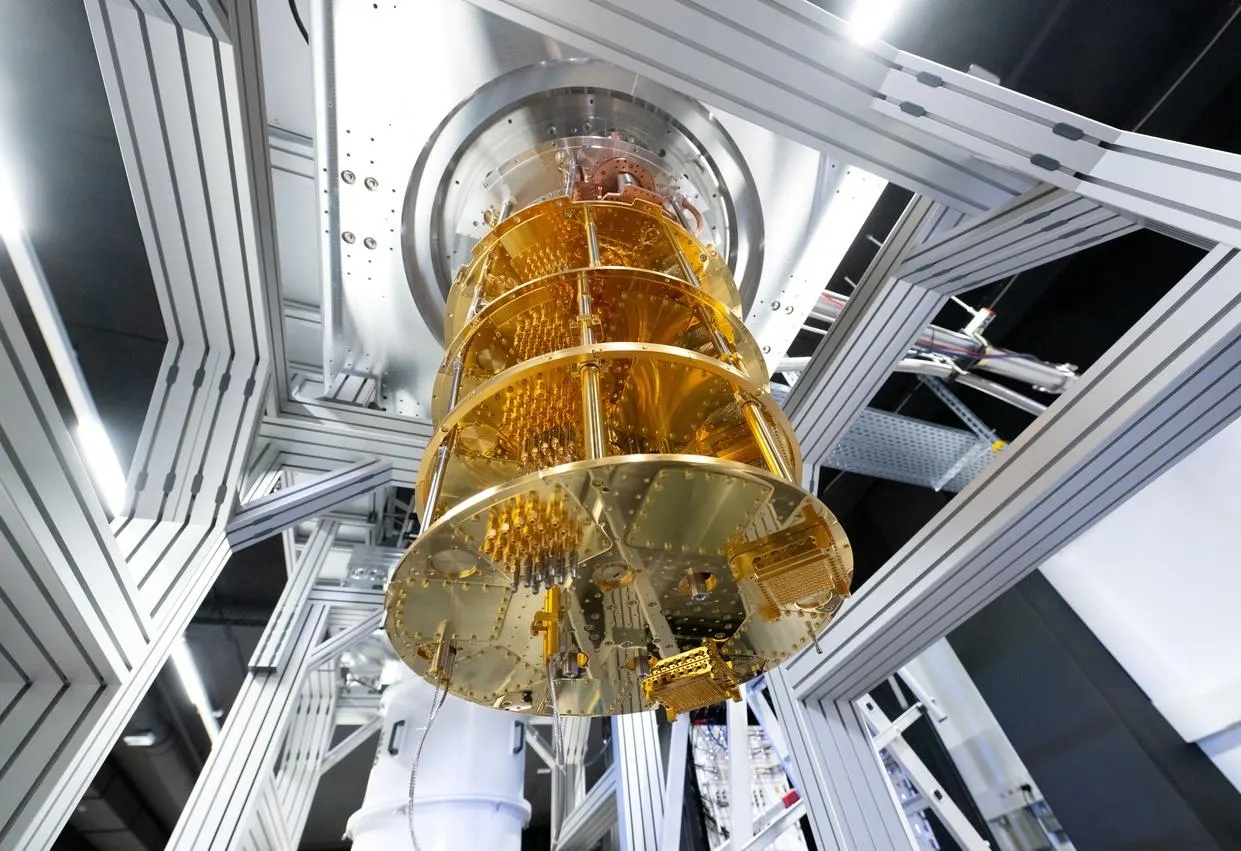
Imagem: Internet
The Hard Problems Still Unsolved
Even with Ising, quantum computing faces headwinds:
- Error Rates. Qubits decohere in microseconds, and noise scales rapidly with system size. Current error-correction schemes require many physical qubits to create a single logical qubit, inflating hardware needs.
- Scalability. Most systems today operate with fewer than 1,000 qubits. Industry estimates suggest millions are required for economically transformative tasks such as breaking RSA encryption or simulating complex molecules.
- Talent and Cost. Cryogenic refrigerators, control electronics, and highly specialized staff push operating expenses into millions of dollars per year for each machine.
- Benchmarks. Standardized metrics for “quantum advantage” remain contested, making vendor claims hard to verify.
Ising’s automated calibration and improved decoding address two of these challenges, but they do not eliminate the fundamental physics obstacles that keep quantum machines confined to laboratories and pilot projects.
Investor Takeaways
For traders, volatility in quantum equities provides opportunities. Stocks often spike on headline catalysts—an Nvidia press release, a government grant, or a research milestone—and then retrace once the excitement fades. Short-term strategies can exploit those patterns if executed with discipline.
Long-term investors should weigh four questions:
- Market Size. Can a $1.9-billion industry growing at 30% annually move the needle for a company the size of Nvidia?
- Open Source. Will open access to Ising dilute Nvidia’s ability to extract economic rents similar to those it enjoys in AI?
- Hardware Neutrality. Does avoiding quantum hardware keep costs low, or does it leave value on the table compared with vertically integrated competitors?
- Partner Selection. If Nvidia’s endorsements gain weight, which of its partners—Infleqtion, PsiQuantum, Quantinuum—are best positioned to capture growth?
Infleqtion’s dual partnership, healthy cash reserves, and comparatively modest valuation make it one candidate. But the company operates in an arena where technical progress, not corporate alliances, will ultimately separate winners from laggards.
Outlook
Nvidia’s move does not guarantee quantum computing will be the “next AI.” The technological leap required is orders of magnitude harder, and the addressable market remains nascent. Still, by leveraging its GPU expertise and making key tools freely available, Nvidia could accelerate the timeline for practical quantum applications. If that happens, today’s start-ups—especially those with strategic partnerships and strong balance sheets—stand to benefit disproportionately. For now, cautious optimism, rigorous due diligence, and an appreciation of extreme volatility remain the prudent posture.
FAQ
Why did Nvidia open-source its quantum software?
Releasing Ising as open source encourages widespread experimentation, accelerates problem-solving, and positions Nvidia’s GPUs as the default classical companion for quantum systems without imposing a proprietary barrier that could slow adoption.
What makes quantum computers faster than classical ones?
Qubits exploit superposition, allowing them to represent multiple states simultaneously. This parallelism enables certain algorithms—such as factoring or optimization—to evaluate many possibilities at once, potentially reducing computation times from millennia to hours or days.
Are quantum computers commercially useful today?
They are primarily in a research and pilot phase. Industries like finance, pharmaceuticals, and logistics are testing algorithms, but large-scale, reliable quantum advantage has not yet been demonstrated for mainstream workloads.
How risky are quantum-computing stocks?
Extremely volatile. Prices often swing double digits on news headlines, and most companies generate little or no revenue. Investors should be prepared for rapid gains and equally rapid pullbacks.
Could open-sourcing Ising hurt Nvidia’s competitive edge?
Yes and no. It may reduce vendor lock-in, but it also broadens the ecosystem that depends on Nvidia GPUs, potentially increasing hardware sales even if software remains freely available.
