

Huawei Launches Passport-Form Foldable Smartphone, Setting the Pace for 2026
The next chapter of the foldable phone race opened in China today as Huawei introduced the Pura X Max, a device that swaps the familiar tall-and-narrow folding format for a passport-style layout that opens horizontally like a book. By putting the handset on sale months—if not years—before similar concepts from Samsung and Apple are expected, Huawei has claimed an early lead in what could become the dominant shape of large-screen foldables.
A wider approach to folding screens
The Pura X Max departs from the elongated portrait dimensions popularized by existing book-style devices. Instead, its compact cover display measures 5.4 inches, presenting a near-square aspect ratio when closed. Once unfolded, users are treated to a 7.7-inch internal panel that offers more horizontal real estate than current mainstream foldables. Both OLED screens boast impressive brightness—3,500 nits on the outside and 3,000 nits on the inside—combined with a fast 1–120 Hz LTPO adaptive refresh rate that should keep scrolling and gaming smooth while conserving power when static content is displayed.
This wider form factor solves a common complaint about traditional book-style foldables: when closed, they can feel awkwardly narrow, leading to cramped typing and letterboxed video. Huawei’s design resembles an actual passport, giving the outer screen a width closer to conventional smartphones and the inner screen a short-and-wide shape that could prove more comfortable for reading, split-screen multitasking, and drawing.
Hardware under the hood
- Processor: Kirin 9030 Pro, a custom 5G-enabled chipset developed in-house.
- Memory and storage: Two main versions—12 GB RAM with either 256 GB or 512 GB of storage; Collector’s Edition with 16 GB RAM and 512 GB or 1 TB of storage.
- Battery: 5,300 mAh with 66 W wired charging and 50 W wireless charging.
- Operating system: HarmonyOS 6.1, which integrates a growing suite of AI utilities and cross-device features.
- Stylus support: Compatible with the Huawei M-Pen 3 Mini.
The Kirin 9030 Pro anchors the performance story. While Huawei has not disclosed benchmark figures, company engineers claim the chip can handle on-device generative AI tasks, advanced image processing, and gaming without throttling. The large battery, bolstered by high-speed charging, positions the phone to compete with the best flagships, potentially offering a full day of heavy use even with the expansive interior display.
Camera system with variable aperture
On the rear, a triple-camera setup aims to satisfy photography enthusiasts:
- 50-megapixel main sensor with a variable aperture that adjusts from f/1.4 to f/4.0 depending on lighting conditions.
- 50-megapixel telephoto lens said to deliver crisp zoom images even in dim environments.
- 12.5-megapixel ultra-wide camera for landscapes and tight spaces.
An AI-driven “pose suggestion” tool offers real-time guidance to subjects by overlaying prompts on the screen, a trend appearing in more camera apps as manufacturers lean on machine learning to help users take social-media-ready pictures with minimal effort.
Pricing and availability
Preorders opened immediately after the launch livestream. Pricing in China starts at 10,999 yuan (about $1,613) for the 12 GB RAM / 256 GB model and tops out at 13,999 yuan (around $2,053) for the 16 GB / 1 TB Collector’s Edition. While no international release has been announced, the company typically waits several months before bringing high-profile hardware to Europe and other regions, often with limited editions due to ongoing export restrictions and supply chain considerations.
Strategic implications for the foldable market
Industry analysts have long speculated that Apple and Samsung will pivot toward wider foldables once hinge technology, display durability, and power efficiency mature. Leaks suggest prototypes under development in both camps, but neither company is expected to unveil a retail product until late 2026. By arriving first, Huawei gains real-world feedback and the chance to refine its second generation before major rivals even enter the arena.
Whether this first-mover advantage translates into global dominance remains uncertain. Huawei’s overseas sales are constrained by trade sanctions that restrict access to Google mobile services and certain 5G components. Inside China, however, the brand retains a loyal base and consistently ranks among the country’s top smartphone sellers. Domestic competition is intense—Oppo, Xiaomi, and Honor have each released multiple foldables—but none yet match the Pura X Max’s wide format.
Software experience and AI focus
HarmonyOS 6.1 emphasizes a universal toolkit of AI enhancements. Beyond camera utilities, the system offers:
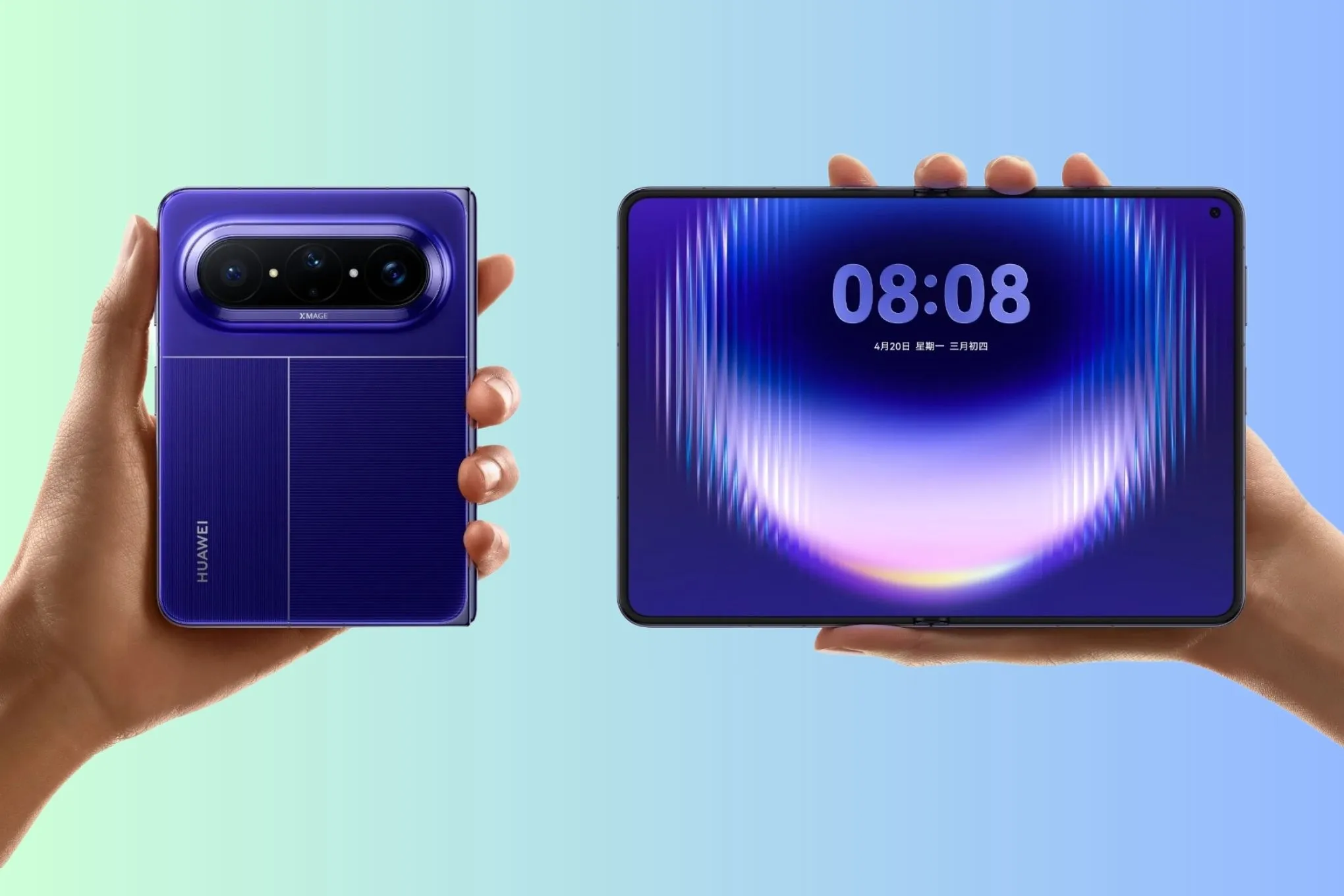
Imagem: Huawei
- Real-time translation during video calls and messaging.
- Contextual screen summarization that distills lengthy articles into bullet points.
- Drag-and-drop multitasking with split-screen presets optimized for the wider display.
- Smart stylus shortcuts that convert handwritten notes into calendar entries or to-dos.
These features rely on on-device processing to minimize cloud latency and preserve privacy—an approach mirroring the broader industry trend toward edge AI. The company has hinted at future updates that will enable generative art directly on the Pura X Max, though release timelines are vague.
Design and durability
Folding mechanisms remain the Achilles’ heel of every bendable device. Huawei says its fifth-generation hinge endures more than 400,000 open-and-close cycles, which equates to roughly ten years of average usage. The internal display is coated with a new proprietary protective layer that the company claims resists scratches and fingernail dents better than previous iterations, while still allowing a crease depth of less than 0.15 mm.
Color options include classic black, pearl white, and two vibrant shades—forest green and sunrise orange—each with a matte glass finish that helps hide fingerprints. The Collector’s Edition adds a vegan leather back and subtle gold trims around the camera module.
What comes next?
Should the Pura X Max generate strong domestic sales, it may pressure competitors to accelerate their own wide-format timelines. For consumers, early availability means the form factor can be tested in everyday life: Will the squarer aspect ratio improve tablet-like tasks? Is the crease distracting? Are wider foldables comfortable in jeans pockets? Feedback to these questions will shape second-generation designs.
Meanwhile, Samsung’s Galaxy Z series and Apple’s rumored iPhone Fold—known only through supply-chain whispers—will face the challenge of differentiating themselves once they arrive. Better ecosystem integration, longer software support, or novel accessories could be their counterpunch. But the advantage of shipping hardware first belongs, at least for now, to Huawei.
For international observers, the most intriguing unknown remains whether the Pura X Max will ever officially land outside China. Regulatory hurdles, component restrictions, and the lack of Google’s app suite have so far confined the firm’s phones to niche appeal in many markets. Still, gray-market imports and tech-savvy enthusiasts may ensure the device gains a presence abroad, even without an official launch.
In any case, the Pura X Max signals a maturation of foldable design. After several years of incremental updates, the category finally seems ready to experiment with form again—and Huawei has fired the starting gun.
FAQ
- How is the Pura X Max different from typical foldable phones?
Most foldables today have a tall cover screen and an interior display that unfolds into a portrait-oriented rectangle. The Pura X Max widens the device, giving it a more square shape when open, which can improve reading, gaming, and multitasking. - What are the storage options?
The standard model offers 256 GB or 512 GB of storage with 12 GB RAM, while the Collector’s Edition provides 512 GB or 1 TB paired with 16 GB RAM. - Does the phone support 5G?
Yes, the homegrown Kirin 9030 Pro chipset includes integrated 5G connectivity. - Can I buy it outside China?
At launch, sales are limited to China. The company has not announced international availability. - Is there Google Play support?
Due to continuing trade restrictions, current Huawei devices ship without native Google services. Users rely on the company’s AppGallery or web-based alternatives. - How durable is the hinge?
The manufacturer rates the hinge for over 400,000 folds, equivalent to opening and closing the device 100 times per day for a decade. - What is the price range in U.S. dollars?
Based on current exchange rates, pricing spans roughly $1,613 to $2,053, though import fees or retailer markups could raise costs elsewhere.
