

Sprint of the Machines: Lightning Robot Rewrites the Half-Marathon Playbook in Beijing
On a clear Sunday morning in Beijing, an unexpected athlete streaked past cheering crowds and into the history books. “Lightning,” a scarlet, two-legged robot created by a team of engineers at the smartphone manufacturer Honor, covered the 13.1-mile course in an astonishing 50 minutes and 26 seconds. The feat not only trounced every one of the 12,000 human runners in attendance but also obliterated the human half-marathon world record of 57 minutes and 20 seconds set by Uganda’s Jacob Kiplimo. Even more striking, three other Lightning units also crossed the finish line in under an hour, signaling a transformative moment for both competitive running and robotics.
A New Benchmark for Robotic Athletics
The latest Beijing Half-Marathon served as the second official year that race organizers permitted mechanical competitors. A season earlier, the field was modest—just 21 robots entered, and only six managed to finish. Most limped to the line in over two hours and 40 minutes. Twelve months later, progress proved exponential. A total of 300 robots drawn from 102 separate development teams toed the starting line. By race’s end, 47 robotic entries completed the challenge: 18 fully autonomous designs and 29 that were remotely controlled by human operators.
Yet the race was dominated by one name. Several versions of Honor’s Lightning took the top four slots, three running independently and one guided remotely. Times were nothing short of sensational. The remote-controlled model recorded the absolute fastest run, posting 48 minutes and 19 seconds. However, event organizers weighted results to favor autonomous systems, awarding victory to the untethered Lightning that finished in 50:26. Second and third places went to additional autonomous Lightnings, clocking 51 and 53 minutes, respectively. The best human runner arrived nearly 20 minutes later, stopping the timer at one hour, seven minutes, and 47 seconds.
Engineering an Elite Mechanical Runner
Lightning’s stunning speed is the result of a year-long development effort that prioritized biomimicry and real-world running physiology. According to lead engineer Du Xiaodi, the team crafted the robot with legs measuring 90 to 95 centimeters (35 to 37 inches) to mirror the proportions of elite distance runners. Each leg articulates through a sophisticated combination of carbon-fiber struts, high-torque actuators, and spring-assisted joints, enabling stride patterns that look unnervingly human at speed.
The project also borrows cooling technology from Honor’s line of smartphones. Miniature liquid reservoirs and micro-channels run through each motor housing, wicking heat away from sensitive electronics as the robot sustains a blistering pace. Without this system, internal temperatures could spike to damaging levels during the roughly 50-minute sprint. Instead, Lightning remained thermally stable, preserving peak efficiency from start to finish.
Software plays an equally critical role. Onboard AI relies on real-time sensor fusion, blending gyroscopic input, lidar mapping, and optical flow data to adapt foot placement across varying pavement textures. Split-second adjustments to ground contact time and stride length maximize energy return through each step. The result is a consistent gait cycle that few humans could emulate, let alone maintain for 13 miles.
A Race That Redefined the Podium
For spectators accustomed to the classic sight of sweat-drenched marathoners bearing down the home stretch, the 2026 Beijing Half-Marathon delivered a surreal twist. Lightning’s bright-red frame appeared almost serene as it glided toward the tape. No ragged breathing, no lactic-acid-induced grimace—just the smooth whirl of servos and the faint hum of cooling pumps.
The bigger surprise came when not a single human claimed a place on the overall podium. Post-event chatter among runners ranged from awe to apprehension. Some viewed Lightning’s triumph as an inspiring testament to engineering, comparing it to Formula 1 racing’s influence on automotive innovation. Others voiced concerns that allowing advanced machines into mass-participation races might eventually overshadow human achievement, distorting the spirit of road running.
From Curiosity to Contender
Lightning’s record run marks a dramatic leap over last year’s robotic showings. Analysts point to several factors driving the improvement:
- Hardware Evolution – Rapid advances in battery density and lighter composite materials shaved precious kilograms from the robot’s frame.
- Software Refinement – Machine-learning algorithms trained on thousands of gait simulations permitted more efficient cadence control.
- Open Competition – A broader field of entrants created a feedback loop of shared learnings, accelerating iterative upgrades across teams.
This momentum mirrors trends in other tech-driven sports. Just as aerodynamics reshaped cycling and sensor-laden swimsuits sparked record sprees in pools, legged robots now threaten to redraw boundaries in distance racing—at least when machines are permitted to line up with humans.
What It Means for Human Competitors
Even though Lightning’s victory does not count toward official human athletics records, the psychological impact remains profound. Runners at every level often chase tangible time goals: breaking a four-hour marathon, dipping under 90 minutes for a half, or elite athletes dream of sub-60. Watching a non-sentient device surpass what the fastest humans can do by nearly seven minutes can feel deflating—or motivating—depending on perspective.
Professional coaches interviewed after the race expressed curiosity rather than dismay. They noted that biomechanics insights gleaned from robotic studies could help refine human training plans. For instance, understanding how micro-adjustments to ground contact time improve efficiency at race pace could translate into new drills and footwear designs.
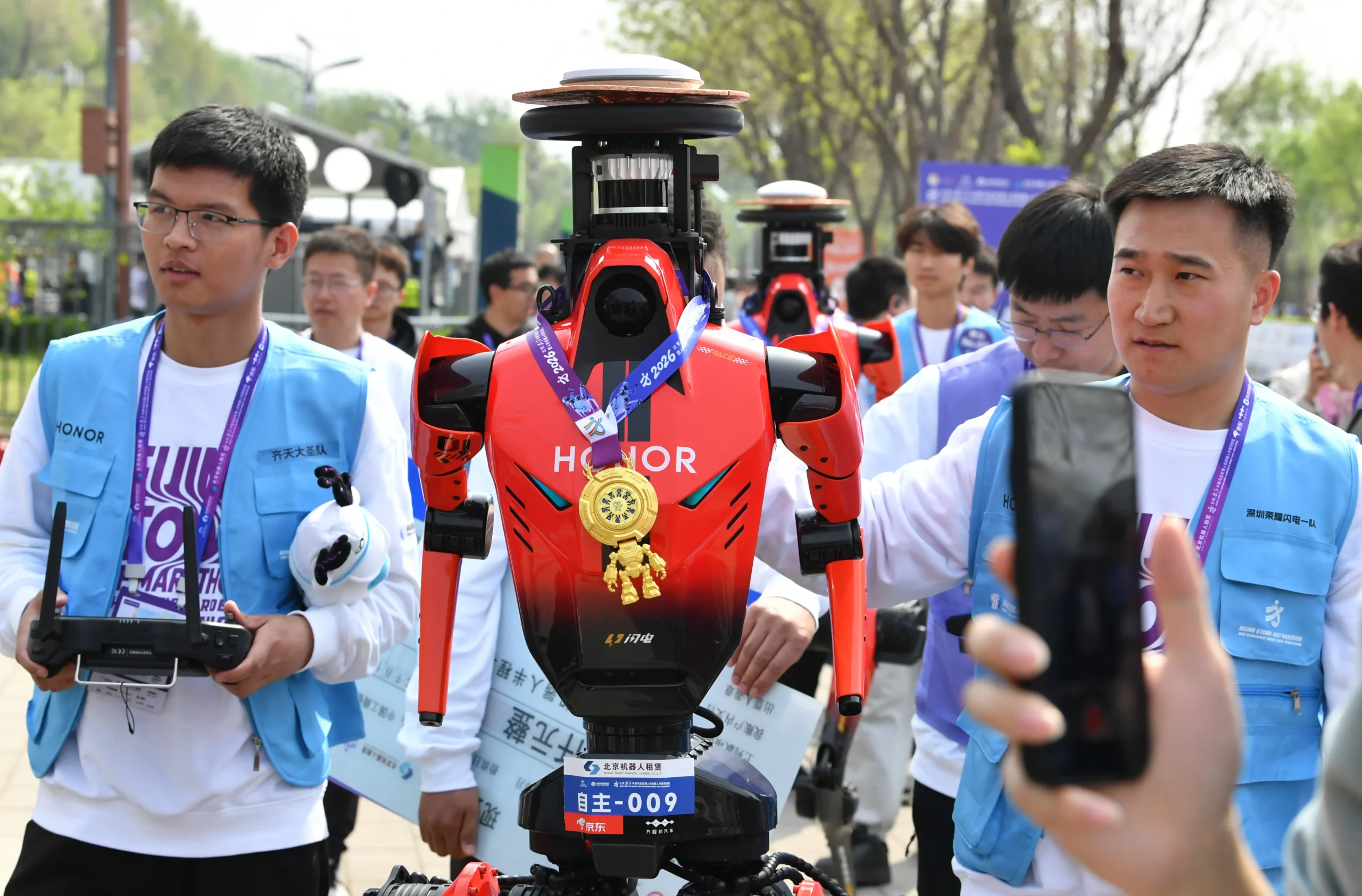
Imagem: Getty
Regulation and the Road Ahead
The Beijing Half-Marathon’s governing body has yet to announce whether future events will continue to blend human and robotic entries or designate separate divisions. Delegates confirmed that rulebooks are under review, with considerations such as course interference, insurance liability, and crowd safety taking center stage. While Lightning and its peers behaved predictably this year, any mechanical failure at race speed could pose significant hazards.
Meanwhile, Honor representatives hinted that Lightning’s success opens doors beyond athletic exhibitions. Potential applications include rapid-response delivery, search-and-rescue in hazardous environments, and even extraterrestrial exploration where agile mobility is paramount. Each use case will demand adaptations—ruggedized casings for debris fields, enhanced autonomy for communications-delayed scenarios—but the core locomotion breakthroughs remain transferable.
Why This Record Matters
Records are storytelling devices as much as they are data points. In the same way Roger Bannister’s four-minute mile redefined human possibility in 1954, Lightning’s 50:26 half-marathon reframes the conversation around legged robots. It is no longer a question of whether machines can finish endurance races; it is how fast they can go, and how their presence should be measured against the achievements of flesh-and-blood athletes.
The juxtaposition raises deeper questions about where technology fits within shared public spaces—from city streets converted into racecourses to the broader cultural stage where sport, innovation, and identity collide. For now, Lightning’s scarlet silhouette slicing through Beijing’s avenues stands as a vivid symbol of that evolving relationship.
Key Takeaways
- Lightning, an autonomous humanoid robot developed by Honor, ran 13.1 miles in 50:26, eclipsing the fastest human time ever recorded for the distance.
- Four Lightning units finished under one hour; a remote-controlled version posted 48:19 but was ranked separately.
- This year’s event saw 300 robotic entrants, with 47 completing the course—drastic improvement over the prior year’s six finishers.
- Engineering highlights include 90–95 cm leg structures, lightweight composites, liquid cooling, and advanced AI gait control.
- The outcome has sparked debate about the future coexistence of human and robotic athletes in mass-participation events.
Frequently Asked Questions
How long is a half-marathon?
A half-marathon measures 13.1 miles, or roughly 21.1 kilometers.
Does Lightning’s time count as an official world record?
No. Athletics governing bodies recognize only human results for official world records. Lightning’s performance belongs to the category of robotic achievements.
Who built Lightning?
The robot was designed and manufactured by engineers at Honor, better known for its consumer electronics, particularly smartphones.
Why was a remote-controlled robot’s faster time not declared the winner?
Race organizers weighted results to prioritize full autonomy. The autonomous Lightning secured first place despite a slower raw time.
Could robots compete in future Olympic Games?
There is currently no pathway for robots to join human athletic competitions at the Olympics. However, separate robotics contests continue to expand globally, and demonstration events may appear alongside future Games.
